
DS Chat is a DarkSingularity chat application. This page tracks the project alongside the rest of the DarkSingularity software archive.
Repository metadata is refreshed from Gitea during the static site build when the build environment has access to the repository.
Repository README
A self-hosted, real-time team chat service in the spirit of Slack/Discord/ Mattermost (channel-based, no threaded conversations) — built from scratch as a full-stack solo project, running in production on my own infrastructure rather than as a demo. Invite-only: there’s no public sign-up, every account comes from an admin invite or a room invite. See ARCHITECTURE.md for the full system design and phased build plan.
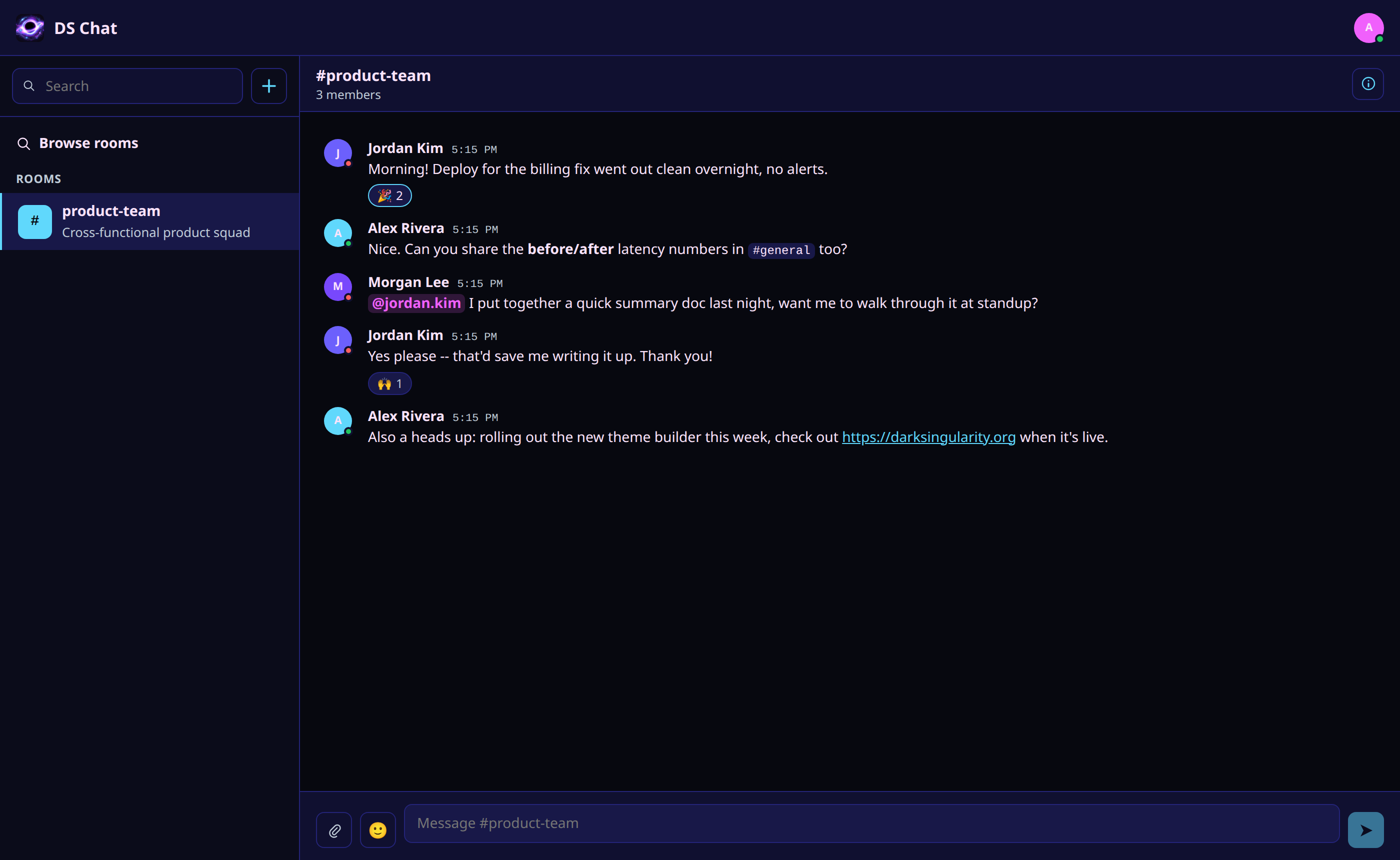
| Custom theme builder | Same room, custom theme applied |
|---|---|
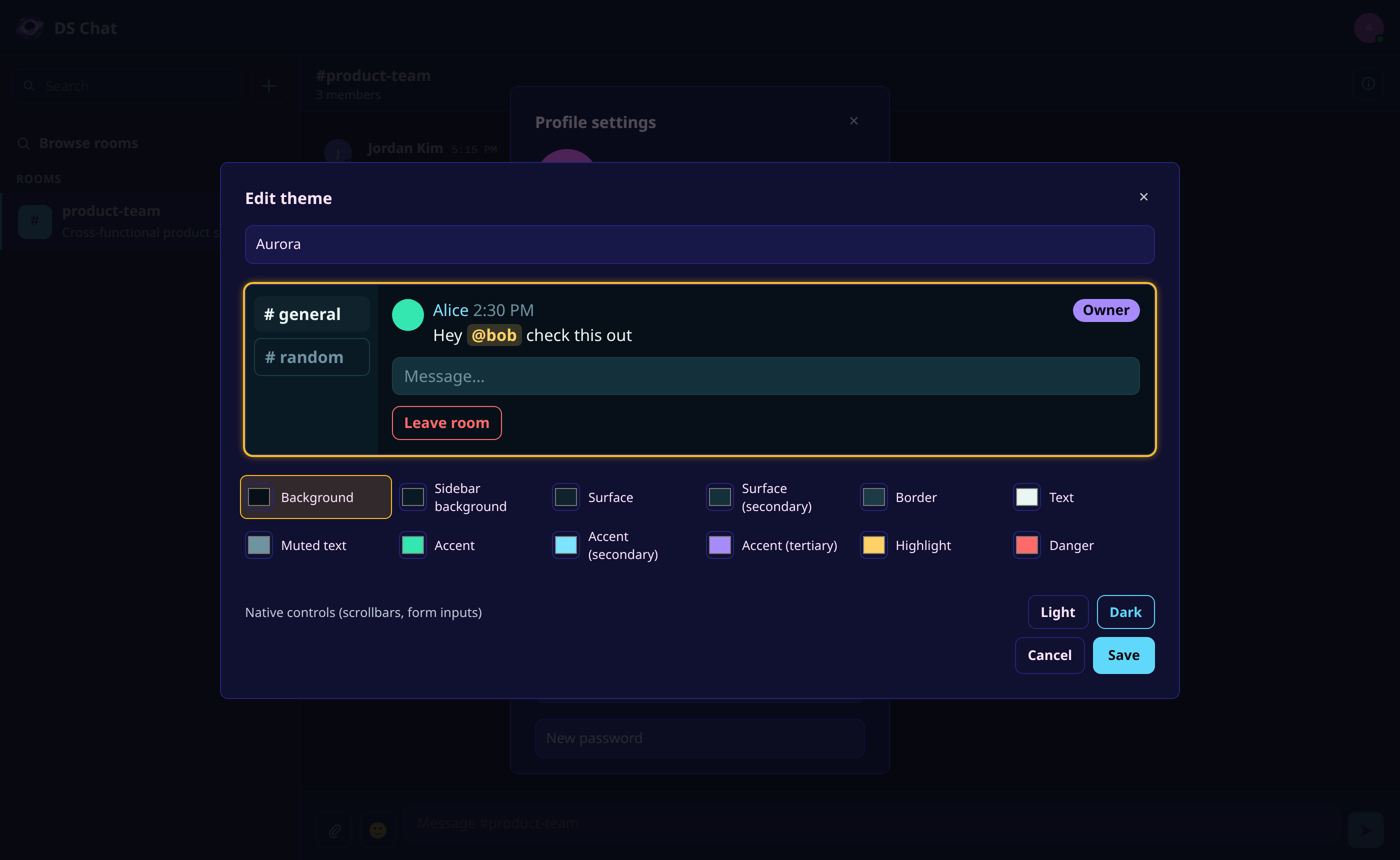 | 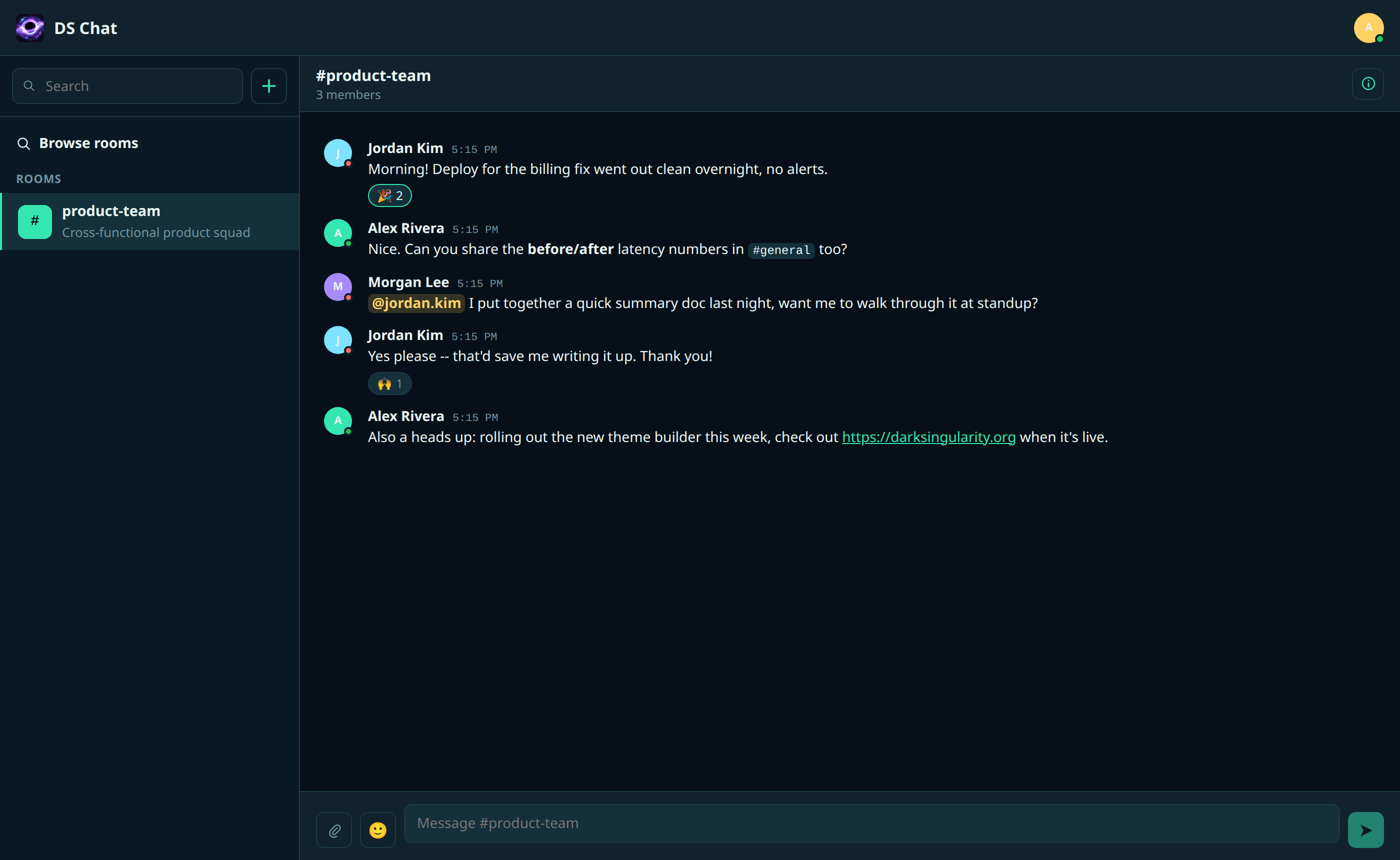 |
Also responsive on mobile — screenshot

Features
- Auth & accounts — server-side, revocable sessions (see every device you’re logged in from and sign one out remotely), invite-only signup (admin-issued site invites or room invites, both delivered by email), password reset, per-user light/dark/midnight/sunset presets plus a live theme builder for fully custom, named, savable color themes.
- Rooms & direct messages — open and private rooms, owner/admin/member roles, invites (with resend), room browsing/search, file/image galleries per room, plus 1:1 direct messages with a collapsible sidebar section.
- Real-time chat — WebSocket-based messaging with automatic reconnect and backoff, Markdown rendering (headings with custom anchors, sub/ superscript, tables, and more), @mentions and #room-reference links with autocomplete and inline highlighting, emoji reactions and shortcodes plus site-wide custom/uploaded emoji, message editing and deletion, image/ video/file attachments (drag-and-drop, paste, or picker) with inline previews and playback, unread indicators, and presence (online/away/ offline, with a manual “appear offline” override).
- Notifications — Web Push and native desktop notifications for offline/backgrounded members, plus email: always-on for direct messages, opt-in per room (first unread message and every mention), all alongside in-app unread badges.
- PWA — installable, offline-capable (cached room/message data, a dedicated offline banner), with automatic update detection that prompts a reload as soon as a new deploy goes live.
- Admin portal — user management, site invites, SMTP configuration, audit log, and management of the bot/webhook system below.
- Bots & integrations — scoped API tokens for bot accounts, incoming webhooks (post into a room from an external system) and outgoing webhooks (signed HMAC event delivery on message create/update), all with SSRF protection on any admin-supplied external URL.
- Scale-out — Redis-backed pub/sub for WebSocket fan-out and presence, so the app runs across multiple horizontally-scaled instances rather than a single process.
Tech stack
- Backend: Python, FastAPI, SQLAlchemy 2.0 (fully async), PostgreSQL, Redis, Alembic migrations, argon2 password hashing, Web Push (VAPID).
- Frontend: React 19, TypeScript, Vite, a hand-rolled WebSocket client with reconnect/backoff and visibility-aware presence, a PWA service worker (Workbox) for offline caching and push.
- Deployment: two bare Debian 13 servers (app + DB/cache), no containers — see DEPLOYMENT.md.
Structure
backend/— FastAPI + SQLAlchemy 2.0 (async) + PostgreSQL + Redis. Seebackend/README.mdfor local setup, migrations, how to create a user (site registration is invite-only — no public sign-up endpoint), and the full API surface.frontend/— React + Vite PWA covering the full feature set: auth, room roles/invites, chat, offline caching, push notifications, and the admin portal. Seefrontend/README.md.
Quickstart
# 1. Postgres (see backend/README.md for details)
docker run -d --name ds-chat-postgres \
  -e POSTGRES_USER=ds_chat -e POSTGRES_PASSWORD=ds_chat -e POSTGRES_DB=ds_chat \
  -p 5432:5432 postgres:16-alpine

# 2. Redis (required — used for cross-instance WebSocket fan-out and presence)
docker run -d --name ds-chat-redis -p 6379:6379 redis:7-alpine

# 3. Backend
cd backend
python3 -m venv .venv
.venv/bin/pip install -e ".[dev]"
cp .env.example .env   # then set SESSION_SECRET
.venv/bin/alembic upgrade head
.venv/bin/python -m app.cli create-user alice alice@example.com "some-password"
.venv/bin/uvicorn app.main:app --reload &

# 4. Frontend (in another shell)
cd frontend
npm install
npm run dev
Then open http://localhost:5173 and log in with the account created above.
The Vite dev server proxies /api and /ws to the backend on :8000, so no
CORS configuration is needed in development.
Deployment
See DEPLOYMENT.md for the full production runbook — two Debian 13 servers, no containers, matching ARCHITECTURE.md §9.
License
AGPL-3.0-or-later — see LICENSE. If you run a modified version of this software as a network service, you must make the corresponding source available to its users (AGPL §13).